Ramadan Barhi dates — the 90-day booking playbook.
Ramadan in the GCC and Central Asia is the week when Khalal Barhi date buyers win or lose their year. Two things determine the outcome: whether you locked volume 90 days out, and whether your logistics stack was set up for the 6-week Ramadan demand spike before it hit. This is the playbook AFRICAFRESH EXPORT walks every wholesaler through.
Why Ramadan Barhi is different
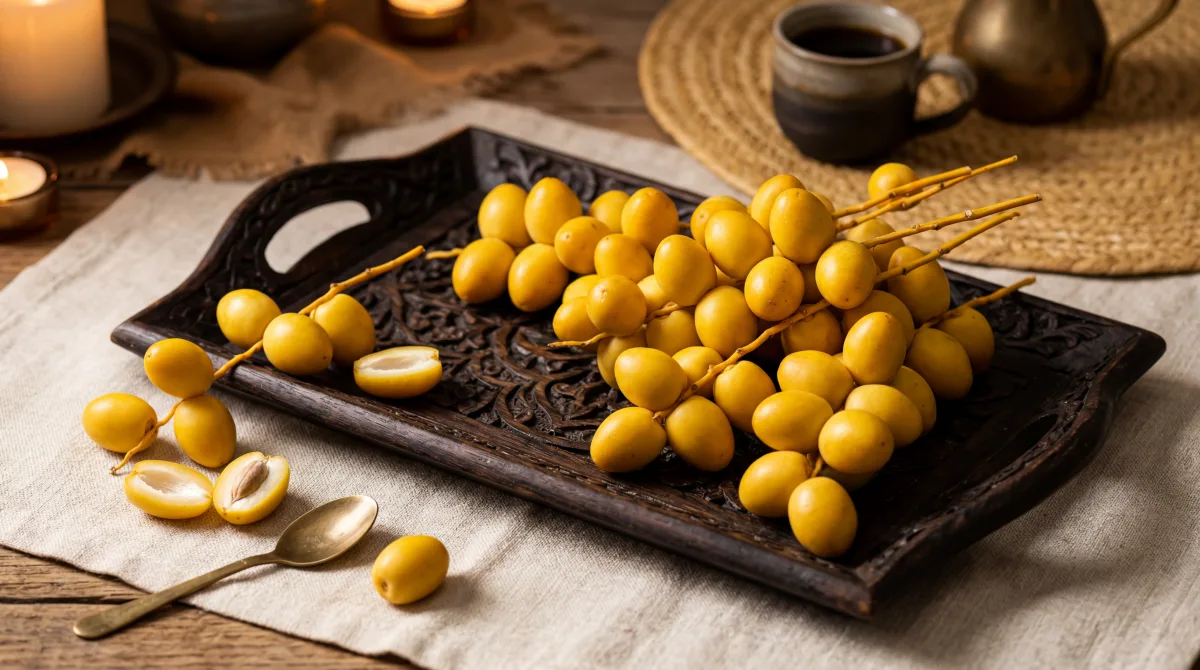
Most date buyers work with dried Medjool, Deglet Noor, Saidi. Ramadan buyers want something specific: fresh Khalal-stage Barhi dates — yellow, crunchy, harvested at 40–60% moisture. Egyptian Barhi is the only commercially available fresh Khalal date in international trade. No competitor origin ships meaningful volumes of fresh Khalal during Ramadan because shelf life is 7–14 days from harvest and the supply chain is unforgiving.
This narrow window is what makes Egyptian Barhi strategically valuable — and also what makes it a logistics problem if you try to book inside the 6-week window.
The 90-day booking clock
Ramadan demand typically runs from 6 weeks before the first day through to end of Eid al-Fitr. The Egyptian Barhi harvest runs July–October, so the calendar puts different buyers on different cycles depending on where Ramadan falls in a given year. Regardless of timing, the booking deadline is structural: AFRICAFRESH EXPORT stops accepting new Ramadan allocations 6 weeks before the first day of the month. Within 6 weeks there's simply no air-freight slot capacity on Cairo–GCC routes to scale supply.
Khalal, Rutab, Tamar — know which stage you're buying
Barhi matures through four stages; the commercial distinction matters enormously for Ramadan.
- Kimri — unripe green; inedible, not commercially shipped.
- Khalal — ripe but firm; yellow, crunchy, moisture 40–60%. This is Ramadan's star.
- Rutab — semi-soft, amber; moisture 30–40%. Commercially shipped for pastry, cooking, and some fresh retail.
- Tamar — fully ripe, dried; moisture <25%. Year-round retail.
For Ramadan specifically, buy Khalal. Rutab is a secondary product; Tamar is not what Ramadan buyers want. Specify the stage on every PO.
Freight — when to air, when to reefer
Khalal Barhi is highly perishable. The default is air freight from Cairo (CAI) to Jebel Ali (DXB), Jeddah (JED), Doha (DOH), Kuwait (KWI), Riyadh (RUH), or Tashkent (TAS). Transit 12–24 hours to GCC, 24–48 hours to Central Asia. Sample cartons arrive within 2 days of harvest; full programmes within 3–5 days door-to-door.
Reefer is viable only for Rutab and late Khalal with firm consistency. Setpoint +4 °C to +8 °C, 85–90% RH. Sea transit GCC 3–5 days is technically within shelf life but leaves little margin on retail side. Most Ramadan programmes run 70% air / 30% reefer for buffer.
Packaging and retail presentation
- 3 kg paper-lined cartons — standard retail pack; individual fruit spaced to prevent bruising. Count per carton: 80–110 (Size M), 60–80 (Size L).
- 5 kg paper-lined cartons — wholesale / HORECA. Bulk fill, no spacing.
- Private-label cartons — with 4-week lead time. Buyer branding + halal-compliant labelling for GCC retail.
- Gift packs — available on request for premium Ramadan retail programmes. Typically 1 kg wooden or PET boxes with ribbon packaging.
What typically goes wrong (and how to avoid it)
1. Booking inside the 6-week window
The single biggest failure mode. AFRICAFRESH EXPORT routinely turns away same-Ramadan enquiries in the last month — not because we don't want the sale, but because air-freight slots are full and we won't commit to volumes we can't deliver.
2. Wrong stage on the PO
Buyer orders "Barhi dates" without specifying Khalal. Supplier ships Tamar. Retail chain rejects. Always specify "Khalal stage, yellow, firm".
3. Temperature break at arrival
Cairo packhouse pre-cools to +4 °C. Air-freight hold is +2 to +4 °C. Destination GCC airport offloads onto tarmac where ambient is 40 °C+ in summer. If onward delivery is delayed more than 45 minutes, product quality degrades within hours. Fix: pre-arrange reefer truck pickup at airport.