Egyptian garlic vs Chinese garlic — a European buyer's sourcing guide.
China supplies roughly 75–80% of global garlic exports by volume. If you are a European importer, distributor, or retail buyer, you are almost certainly buying Chinese garlic at some point in your calendar. The question is no longer "Egyptian vs Chinese" — it is "where does Egyptian garlic fit alongside my Chinese supply, and under what circumstances does it become the primary origin?" This is the honest working answer from the AFRICAFRESH EXPORT sourcing team.
Quick-reference comparison
Based on 2023–2025 average seasons. Individual campaigns and specifications vary significantly.
| Criterion | Egypt | China |
|---|---|---|
| Peak harvest window | January–April (fresh); through August (dried) | May–July (primary); year-round from storage |
| EU import tariff | Reduced / zero — EU-Egypt Association Agreement | Standard EU tariff (9.6% + anti-dumping duties on some classifications) |
| Transit to Rotterdam (reefer) | 6–10 days (Alexandria/Port Said) | 25–35 days (Shanghai/Qingdao) |
| MRL compliance track record (EU) | Clean — consistent with EU Directive 2002/63/EC standards in EFSA monitoring data | Higher interception rate in RASFF notifications for pesticide residues (chlorpyrifos, methyl bromide) |
| FOB price (per tonne, rough average) | USD 550–850/t depending on caliber and grade | USD 400–700/t (White variety, class 1) |
| GlobalG.A.P. certification | Standard for AFRICAFRESH EXPORT partner farms | Not standard; available from select exporters only |
| BRCGS packhouse audit | Available through AFRICAFRESH EXPORT supply chain | Variable; requires buyer-side audit investment |
| Traceability (farm-to-carton) | QR-tracked per carton (AFRICAFRESH EXPORT standard) | Batch-level typical; farm-level rare outside premium programmes |
| Varieties available | White, Balady, Red, Chinese-type, Green/Dry | Much wider variety base; Purple, Solo, Elephant, White |
| Year-round supply | Jan–Aug (fresh + dried); gap Sep–Dec | Near year-round from controlled-atmosphere storage |
| Private-label / retail-ready packaging | Yes — 3–4 week lead time at full-container MOQ | Yes — very competitive; wide packaging options |
Highlighted cells indicate the stronger position in our experience. Individual exporter capability varies on both origins.
Why European buyers are adding Egyptian garlic
MRL and RASFF exposure
The EU Rapid Alert System for Food and Feed (RASFF) has logged a disproportionate share of fresh garlic border rejections against Chinese-origin shipments over the past decade — notably for chlorpyrifos, methyl bromide fumigant residues, and dithiocarbamates exceeding EU MRLs. Egyptian garlic, grown under GlobalG.A.P. protocols with pre-shipment testing at Cairo-accredited laboratories, generates a materially lower rejection rate in EFSA monitoring programmes.
Practical implication: A major EU retail buyer running a private-label garlic programme can face reputational and regulatory exposure if a consignment triggers a RASFF notification. Adding Egyptian origin as a documented, certified backup to the supply base provides a tested compliance hedge — not a full replacement.
EU tariff advantage
Under the EU-Egypt Association Agreement, Egyptian garlic enters the EU at preferential duty rates. Chinese garlic faces the standard EU tariff of 9.6% and in some import periods has faced additional anti-dumping measures. On a 26-tonne reefer container, the tariff differential alone can amount to €5,000–12,000 per container depending on the FOB value and classification, partially offsetting Egypt's somewhat higher FOB price.
Transit time and cold-chain simplicity
Alexandria to Rotterdam by reefer is 6–10 days. Shanghai or Qingdao to Rotterdam is 25–35 days. For buyers running a just-in-time garlic programme — common for retail chains managing fresh-category inventory against weekly sales — the Egyptian supply chain allows reorder cycles that are simply not possible from China. Shorter transit also means lower in-transit quality loss risk on fresh (as opposed to dried) garlic.
Supply-chain diversification
Since 2020, buyers who relied on single-origin Chinese garlic faced repeated disruptions: port congestion in 2021, container shortage in 2022, and ongoing freight rate volatility on the Asia–Europe lane. Adding a Mediterranean origin — Egypt, Spain, or Argentina — is now standard supply-chain practice for any programme buying more than 200 tonnes per year. Egypt is the only Mediterranean origin available January through April at meaningful commercial volumes.
Where China clearly wins
Year-round supply continuity
China can supply garlic 12 months a year, in consistent grades and calibers, from a large base of controlled-atmosphere storage facilities. Egypt cannot. The September–December gap in Egyptian supply is a real limitation. Most buyers who add Egypt to their supply base continue to source China for Q4 coverage.
Volume and variety depth
Chinese garlic production is approximately 20 million tonnes per year (FAO data, 2022). Egypt's total garlic production is roughly 250,000–300,000 tonnes per year, with perhaps 15–25% available for export. For a buyer requiring 1,000+ tonnes annually in a single consistent grade, China is often the only origin that can commit to full-year volume contracts. Egyptian supply is better suited to 50–300 tonne per campaign programmes, or as a certified-origin top-up to a Chinese base volume.
Price
Chinese White garlic FOB price is typically USD 100–200/t lower than comparable Egyptian White. After adding EU tariff and freight, the landed-cost gap narrows substantially in Europe, but on pure commodity metrics China remains the lower-cost origin for buyers who can absorb the compliance and transit overhead.
Egyptian garlic varieties and specifications
Five commercially exported types:
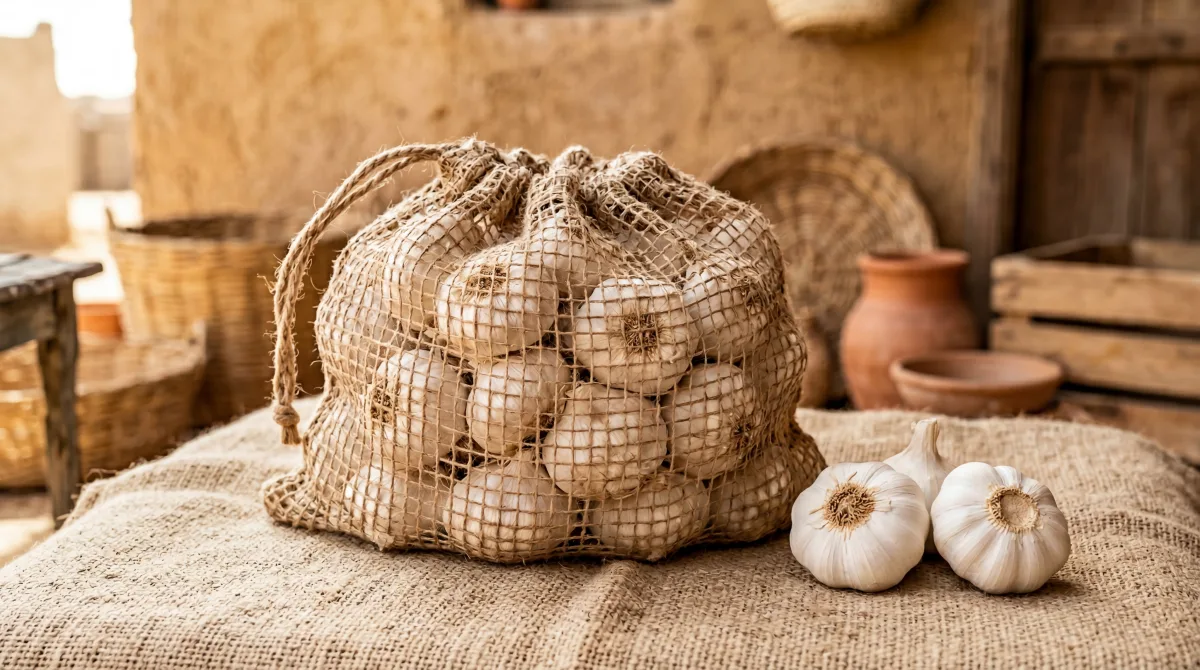
- White (primary export grade) — 40–80 mm caliber, tight skin, high pungency, 8–12 cloves per bulb. Packed telescopic or open-top carton (10 kg, 20 kg) or mesh bag. This is 80%+ of AFRICAFRESH EXPORT garlic volume.
- Balady (indigenous Egyptian) — smaller bulb (40–60 mm), stronger flavour profile, traditional Egyptian and Central Asian retail preference. Limited planted area; allocates to preferred buyers.
- Red — purple-tinged skin, GCC and Central Asian preference for flavour intensity. Smaller volume.
- Chinese-type (grown in Egypt) — seed stock of Chinese origin grown under Egyptian conditions and Egyptian phytosanitary regime. Larger bulb profile, milder flavour. Benefits from Egyptian MRL track record despite genetic origin.
- Green / Dry garlic — green garlic ships February–March; dried extends through August.
Season and availability
| Month | Egyptian availability | Chinese availability |
|---|---|---|
| January–February | Fresh green + early White harvest; very limited | Dried from storage (full range) |
| March–April | Peak fresh White and Balady; best quality window | Dried from storage; new-crop transition |
| May–June | Dried/cured White shipping; supply eases | New Chinese harvest starts; peak quality |
| July–August | Dried garlic only; volumes declining | Peak Chinese supply; lowest FOB of year |
| September–December | Gap — no meaningful Egyptian supply | Full year-round supply from controlled-atmosphere storage |
The optimal programme structure
Most European buyers who add Egyptian garlic run a complementary programme, not a replacement:
- China as base volume (60–70% of annual requirement): year-round supply continuity, lowest FOB cost.
- Egypt for Jan–Jun primary-season top-up (20–30%): certified fresh garlic with GlobalG.A.P. documentation, shorter transit, retail-label compliance hedge.
- Spain or Argentina for the Q4 gap (10–20%): European origin for private-label retail that requires "Product of Europe" labelling.
For buyers specifically seeking a non-China majority origin — driven by retail buyer specifications, import compliance risk management, or consumer positioning — Egypt becomes the primary origin for Jan–Jun with Spain, Morocco, or Argentina covering Q4. This requires higher total FOB cost and is typically only commercially viable for premium or certified-origin retail programmes.
Frequently asked questions
Is Egyptian garlic cheaper than Chinese garlic?
Chinese garlic has a lower FOB price per tonne. However, the landed-cost gap in Europe is smaller than it looks: Egyptian garlic benefits from zero EU tariff under the EU-Egypt Association Agreement, 6–10 day reefer transit vs 25–35 days from China, and lower pre-shipment MRL testing overhead for retail programmes. For buyers who require detailed residue documentation, total cost of Chinese garlic is often higher once compliance overhead is included.
Why are European buyers switching to Egyptian garlic?
The primary drivers are EU MRL compliance risk (Egyptian garlic has a consistently cleaner RASFF record), supply-chain diversification after 2020–2022 Asia-Europe logistics disruptions, and retail messaging preferences. Egypt cannot replace China on volume, but it is the most viable Mediterranean certified-origin alternative for buyers who need a documented non-China supply line in their base.
What is the minimum order for Egyptian garlic?
One 40ft reefer (approximately 24–26 tonnes of garlic) is the standard minimum for sea freight. Air-freight orders start from 100 kg. AFRICAFRESH EXPORT can also consolidate garlic with other Egyptian commodities (onions, potatoes) for buyers who want mixed-SKU reefer containers below the single-product MOQ.