Egyptian pomegranate export guide — Wonderful, Manfaluti, Baladi, and Early 116.
Global pomegranate demand has grown at approximately 6–8% per year through the 2020s, driven by health-food positioning, functional beverage growth, and expanding aril markets in food service. Egypt is a major origin — ranking consistently in the top 5 pomegranate exporters globally — with a September–March window that lands precisely in the gap between Turkish and Southern-Hemisphere supply. This is the working buyer's guide from the AFRICAFRESH EXPORT sourcing team.
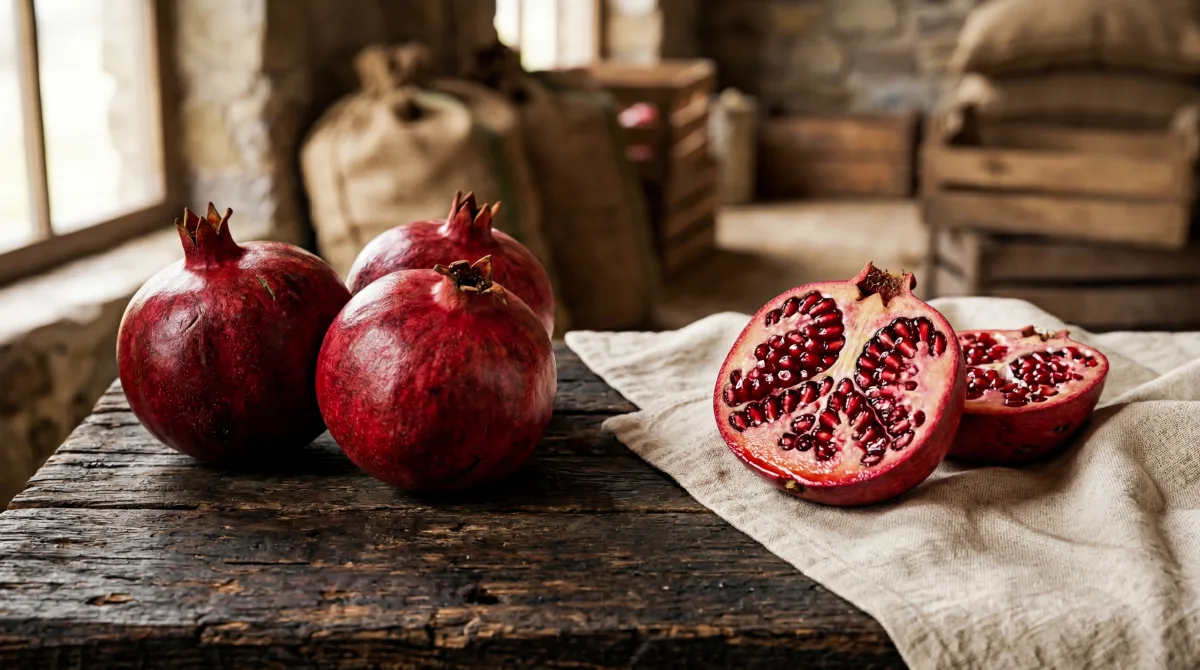
The four cultivars
| Variety | Season | Brix | Best use |
|---|---|---|---|
| Wonderful | Sep–Nov (fresh); to Dec–Jan from CA | 15–17 | European and GCC fresh retail, arils processing, juice |
| Early 116 | Late Aug–Sep (earliest on market) | 12–14 (early harvest) | Early-season retail premium; limited volume |
| Manfaluti | Sep–Nov | 14–16 | Egyptian domestic preference; niche European and GCC retail |
| Baladi | Sep–Oct | 13–15 | Juice extraction, processing buyers |
Wonderful: the international benchmark
Wonderful is the global pomegranate standard — the same cultivar dominating California, Israeli, and Peruvian production. Egyptian Wonderful grown in Nubaria and Fayoum averages Brix 15–17, dark-red arils, hard shell (15–20 mm thickness), and counts 6, 8, 10, 12, or 14 fruit per 11 kg open-top carton. Shell integrity survives a 10-day reefer to Rotterdam and a 14-day reefer to the Far East. This is the variety that fills European retail shelves and GCC hypermarkets.
Early 116: the season opener
Early 116 is Egypt's earliest-harvest commercial pomegranate — available from late August, 3–4 weeks before Wonderful. It commands a 20–30% FOB premium for buyers who need to be first to market. Brix is lower (12–14 at early harvest, rising to 14–15 by mid-September), and volumes are limited. GCC luxury retail and European specialty chains book Early 116 programmes on allocation.
Packaging and grades
Export packaging options for Wonderful and Manfaluti:
- 11 kg open-top carton — standard export grade. Counts: 6 (extra-large), 8 (large), 10, 12, 14 per carton. Each fruit individually wrapped in foam net or tissue. This format ships to Europe, GCC, and East Asia.
- 2 kg consumer tray — retail-ready, 4–6 fruit per tray. For buyers running pre-packed retail programmes in GCC hypermarkets and European multiples. Usually overpacked in a 10 kg master carton.
- Bulk bin (200 kg) — for arils processing and juice extraction buyers who sort and process at destination. Grade 2 and processing-quality fruit.
Shelf-life reference: Egyptian Wonderful in an 11 kg open-top carton, pre-cooled to +5–7 °C at packhouse, maintains marketable external appearance for 8–10 weeks in retail refrigeration conditions (4–8 °C). Aril condition degrades faster — retail programmes running more than 6 weeks post-harvest should request CA-storage origin.
Season calendar and competitive origins
| Month | Egypt | Competing origins |
|---|---|---|
| August | Early 116 (limited volume) | Spain (early), Turkey (early) |
| September | Wonderful peak starts; Early 116 tailing | Spain (peak), Turkey (peak), Israel (early) |
| October | Wonderful full peak — best quality and price | Spain, Turkey, Israel (all at or near peak) |
| November | Wonderful still strong; CA-stored fruit entering | Spain tailing; Turkey tailing; Peru starting |
| December | CA-stored Wonderful; quality declining | Peru (strong start); Chile (early) |
| January–March | Very limited — CA tail only | Peru and Chile (primary Southern Hemisphere window) |
Egypt's strongest position is October–November — when Turkey and Spanish supply are tailing and Southern Hemisphere volume has not yet arrived. For European buyers who want to run an unbroken pomegranate programme across the full autumn, Egypt and Peru are typically complementary, not competing: Egypt Jan–Nov, Peru December–April.
Why Egyptian pomegranate wins on price vs Israel and Spain
At comparable Brix and caliber, Egyptian Wonderful FOB is typically 20–35% lower than Israeli Wonderful and 10–20% lower than Spanish Wonderful at equivalent weeks in the season. Three structural reasons:
- Farm-gate labour cost — Egyptian agricultural labour is among the lowest-cost in the Mediterranean region.
- Land and water cost — Nubaria reclaimed-land irrigation has lower cost base than Israeli drip-irrigation programmes.
- EU preferential tariff — Under the EU-Egypt Association Agreement, Egyptian pomegranates enter the EU at reduced duties, partially closing the landed-cost gap vs Spanish (zero-tariff, EU domestic) supply.
Arils: the growing end-use
Fresh pomegranate arils are the fastest-growing pomegranate end-use in European and GCC food service. AFRICAFRESH EXPORT sources from BRCGS-certified processing facilities in Egypt that supply:
- 200 g vacuum packs — restaurant and café portion size
- 400 g vacuum packs — HORECA bulk
- 1 kg vacuum packs — food manufacturing input
Arils are processed within 24–48 hours of harvest and air-freighted. Shelf life in refrigeration is 7–10 days from processing. Frozen arils (IQF) are also available for buyers with blast-freeze infrastructure — shelf life 18 months at -18 °C.
Certifications and documentation
- Phytosanitary Certificate — Egypt MALR / CAPQ. Required by all destinations.
- GlobalG.A.P. — farm-level; AFRICAFRESH EXPORT partner standard.
- BRCGS Food Safety — packhouse-level; available for retail and arils programmes.
- EUR.1 / EUR-MED — certificate of origin for EU preferential tariff.
- Pesticide residue report — pre-shipment MRL analysis; travels with cargo.
Transit to key markets
| Destination | Transit (reefer) | Transit (air) |
|---|---|---|
| Rotterdam / Hamburg | 6–9 days | 24–48 h |
| Jebel Ali (UAE) | 4–6 days | 12–24 h |
| Doha / Dammam | 5–7 days | 12–24 h |
| Singapore / Hong Kong | 14–18 days | 24–36 h |
| Tashkent | 14–18 days (via Poti) | 24–48 h |